
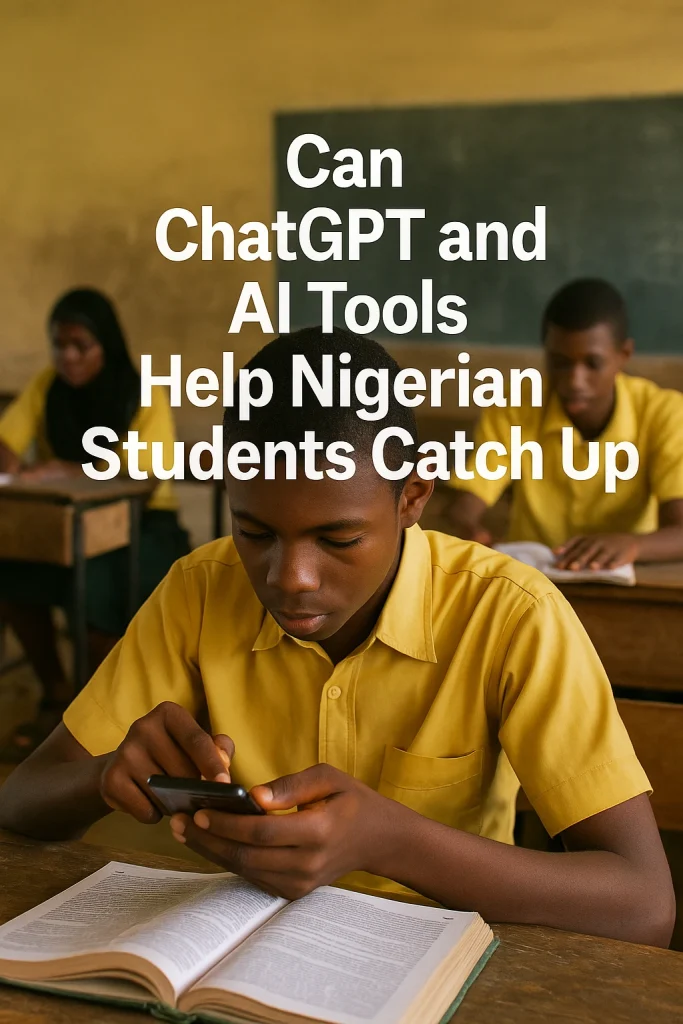
For many of us who grew up in Nigeria, the image of a typical classroom hasn’t changed much in decades—overcrowded benches, a blackboard barely visible from the back, and an overworked teacher doing their best with limited resources. Yet, somehow, we made it work. But the world has changed, and so have the demands of education.
In recent years, technology has thrown open the doors to new possibilities, and tools like ChatGPT have entered the scene. It makes you wonder: can artificial intelligence really help Nigerian students catch up, especially after years of disrupted learning, teacher shortages, and underfunded schools?
Let’s unpack that together.
The State of Things: A Learning Gap Widening
We need to be honest with ourselves—our education system is in a rough place. WAEC and JAMB scores are dipping, more children are out of school than ever before, and university students are constantly navigating the uncertainty of ASUU strikes.
When schools do open, they’re often struggling with outdated curricula, a lack of textbooks, and teachers who are spread thin. For students, especially in rural areas, the learning gap is no longer just about what’s taught in class. It’s about what’s not being taught—because there simply isn’t enough time, support, or infrastructure.
So What Can AI Do?
Now, this is where things get interesting. ChatGPT—and tools like it—are like digital tutors, available 24/7. Imagine a student in Kaduna, stuck on a math problem at 9 p.m., typing a question into their phone and getting a simple, clear explanation in seconds. Or a secondary school student in Owerri getting help drafting an essay for WAEC.
These tools don’t just offer answers; they offer guidance:
- Breaking down complex topics
- Practicing grammar and writing
- Helping with revision for science subjects
- Translating hard English into understandable explanations
And it’s not just ChatGPT. Apps like Khan Academy, Socratic, and local platforms like uLesson are making learning more accessible, especially for students who are self-driven.
But Let’s Be Real—There Are Limits
Of course, it’s not all rosy.
First off, there’s the issue of access. Not every student has a smartphone or reliable internet. In fact, many don’t. And even when the tools are available, there’s the risk of misuse—students copying and pasting AI responses without truly understanding the material.
Then there’s the human element. Can a chatbot truly replace a teacher’s warmth, their stories, their intuition? Not really. At best, AI is a companion, not a replacement. Students still need to develop critical thinking, discipline, and emotional intelligence—things no app can teach.
It’s Already Happening—Quietly
Here’s the thing: some students and teachers in Nigeria are already using AI tools—and benefiting.
I recently spoke to a teacher in Lagos who encouraged his SS3 students to use ChatGPT for revision. Not to cheat, but to explore difficult topics from different angles. “It made them curious,” he said. “They came to class asking smarter questions.”
And a friend’s niece in Benin learned how to write a better CV using ChatGPT—something her school never taught her. These might seem like small wins, but they’re the kind of interventions that shift mindsets and open doors.
What Needs to Change?
If we want more Nigerian students to benefit from AI tools, we need to lay the foundation:
- Digital access must be prioritized—affordable internet, subsidized devices, and infrastructure in rural schools.
- Teacher training is key—AI can’t help students if educators are afraid or unsure of it.
- Parental involvement—someone has to help younger students navigate these tools responsibly.
- Policy support—EdTech should be embedded in our national strategy, not treated as an afterthought.
So, Can It Help?
Yes, AI tools like ChatGPT can help Nigerian students catch up—but only if we let them. Only if we build the bridges between technology and the realities of our classrooms.
It’s not about replacing what we have, but enhancing it. Giving students who are already behind a fighting chance. Making knowledge available beyond school walls. And maybe, just maybe, giving a JSS3 girl in Maiduguri the same access to explanations and learning as a private school student in Lekki.
We can’t afford to leave our students behind. And in this digital age, we don’t have to.
Would you like me to design a header image or write a social media caption to promote this blog post?
